
How to make an effective revision sheet?
Exams are approaching or there are many assessments throughout the year, it is time to start preparing for revision. Among the different learning methods, review sheets are often used to summarize information and facilitate memorization.
It is essential to know how to make an effective revision sheet so as not to waste time and obtain better results.
In this article, we will give you practical advice for creating your revision sheets so that they are effective and optimized.
What is a revision sheet for?
A revision sheet is a very useful tool for middle and high school students who are looking to better understand and, above all, retain information from a course or on a specific subject. It helps summarize key knowledge and ideas in a concise, easy-to-read format.
A revision sheet aims to structure knowledge and organize it in a logical manner, which makes memorization easier. They can also be used as a quick reference when preparing for an exam or test so that you do not reread the entire course, but concentrate on the essentials.
As well as providing an overview of important information, review sheets can also include diagrams, graphs and tables to help with visualization. The revision sheet can be used in an active learning method with highlighting, repetition and reflection to reinforce knowledge.
Materials for good revision sheets
A good revision sheet requires, above all, good note-taking. Depending on the level of study and preference, note-taking may be different: in writing or on a computer.
Good note-taking will lead to good revision sheets with the essential elements to remember from the course.
To create effective revision sheets, it is therefore important to use good materials.
First of all, it is advisable to use high quality paper or card stock to create durable and easy to handle cards.
Clairefontaine paper is a safe bet for taking notes as well as creating revision sheets.
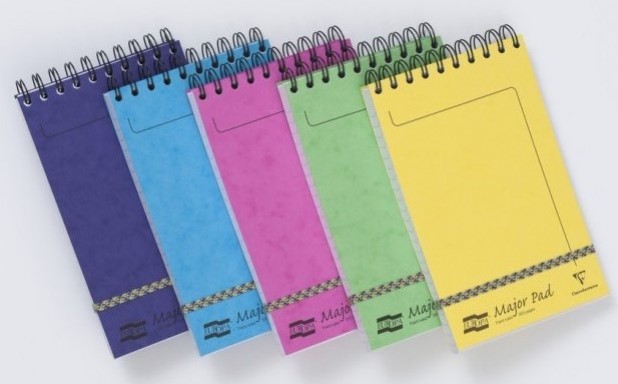
The loose sheets and double copies Clairefontaine can be a perfect first possibility for learning. The paper provides daily comfort of use and superior resistance.

Clairefontaine colored sheets provide valuable assistance for optimal organization since each material corresponds to a color.
The course blocks are one of the best alternatives. These are perfect supports for creating revision sheets. With exceptional paper quality, it is possible to use a course block per subject in order to be able to centralize all the revision sheets so as not to search for them later.

Using tracing paper can be an effective solution for creating graphs, diagrams or even drawings. The transparency of Clairefontaine tracing paper is a great alternative to highlight an evolution in the graph. Diagrams are important to help organize and visualize key information, making it easier to understand and remember.
By using these tools, it is possible to create personalized and effective revision sheets to optimize your learning time.
Our advice for effective files
At Clairefontaine, we support middle and high school students in succeeding in their exams and studies.
Find our five tips for effective revision sheets:
Do not copy
A revision sheet is not there to copy the course in its entirety. It is important to summarize, synthesize the course to have only the essential elements.
The synthesis must be done with the words of the student and not with those of the teacher, this allows you to take possession of the course and understand what is written.
Make handwritten notes
It takes more time than on the computer, but writing allows you to remember lessons in the long term. Writing is a recognized method for learning and memorization, coupled with breezy and attractive content, which allows you to enjoy revising for tests or exams.
Get to the point
The purpose of a revision sheet is to summarize the lessons, there is no need to highlight elements which are not essential to understanding the lesson. It will be necessary to highlight the key words and phrases of the course in an organized manner.
The titles as well as the subtitles will help to structure the file.

Use color
Color should be used sparingly, it should make sense. Each color must have a function to bring out this or that information at a glance.
Purple for definitions, black for the course plan, red for the key words… It doesn’t matter what the colors are, the most important thing is toappropriate color code.
Personalize the files
The format and color are the first customizations, but it can go further. Personalizing a revision sheet will make it more attractive and therefore make you want to read it.
But be careful, this should not become a work of art. Personalization must serve learning.