
What paper and material to choose for making origami?
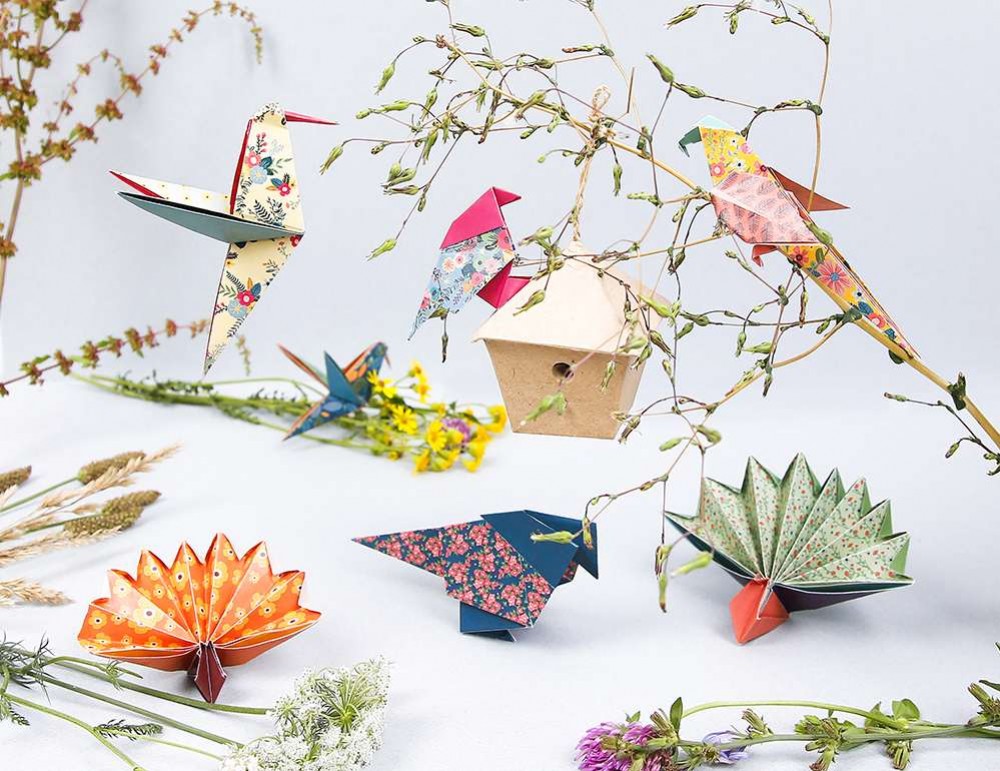
Origami, the painstaking process of folding paper to create shapes and structures, is loved around the world for its delicate balance between simplicity and complexity. However, creating striking origami works begins well before the first folds. A crucial point in the origami process is the choice of paper. With a huge selection of papers available, from lightweight to more textured, how do you determine which one will suit your origami creation?

What is origami?
Origami is the traditional Japanese art of paper folding. A simple sheet is transformed into a three-dimensional work, revealing shapes as simple as they are complex: animals, decorative objects, geometric shapes.
The name Origami comes from the Japanese words “oru” (to fold) and “kami” (paper), thus reflecting the very essence of this art: folding paper to bring a creation to life. This fun activity is accessible to everyone, beginners and experienced alike.
Over the years, origami has been enriched with various techniques and styles. Some people prefer minimalist, clean designs, while others venture into intricate, careful compositions that require hours of attention to detail and patience.
The practice of origami has many advantages since it promotes concentration, precision and perseverance, while stimulating creativity. Transforming a sheet of paper into an elaborate sculpture is a meditative and relaxing experience for the mind that invites reflection.
The art of origami perfectly illustrates the way in which art and technique can combine to create masterpieces from a simple medium.
What material to choose for making origami?
For practicing origami, you will not need to buy a lot of materials.
An essential element for this practice, the choice of paper is essential to guarantee the success of your creations. The ideal paper should preferably be thin and have good hold.
For the practice of traditional origami, the paper must have a square format. If you have A4 size sheets, a pair of scissors may be necessary to resize the paper.
You can still use certain accessories to help you, particularly for marking folds.
Basic tools and materials may include a ruler to accurately measure folds, a smooth work surface to prevent snags, and a grooved board to help bend straight lines. Folders, the smallest accessory, can be useful in order to facilitate your experience in order to mark the folds preciselye.
Apart from the choice of material, two elements are essential in the practice of origami: patience and practice. Origami can be a delicate art that requires concentration and precision. Be prepared to try several times and practice to perfect your skills. Over time, you will become more and more skilled and will be able to create more complex models.
Origami remains an activity very close to scrapbooking, find the materials when you start.

Choose the right paper to make origami
There are different types of origami papers to carry out this activity, it all depends on your desire and your level in the practice.
Paper thickness is a key factor to consider. Paper that is too thick will make folds difficult to make and maintain, especially for the most complex models. Conversely, paper that is too thin risks tearing easily. It is therefore important to choose paper of medium thickness. Most origami papers sold have a thickness of 60 to 80g/m², which is ideal.
The texture of the paper is also important since it can help hold creases in place. A slightly rough paper, with a certain resistance, is therefore preferable for origami.
You can find simple and colorful origami paper, but also papers with patterns and prints. Solid colored papers are great for beginners as they allow you to concentrate on folding techniques.
Patterned or printed papers can give an original touch to your creations, but it is important to consider the complexity of the patterns in relation to the complexity of the chosen origami model.
The reverse side of the paper can be an interesting element to take into account. Some origami papers have a white reverse side, while others have the same color or a different pattern on the other side. Depending on the model you have chosen, it may be interesting to work with a paper with patterns or contrasting colors on each side.

Types of paper for making origami
kami paper is traditional Japanese paper specially designed for origami. It is lightweight, easy to fold and available in a wide range of colors. This is the best choicefor beginners.
tissue paper is a thin, delicate paper, often used for more advanced designs. It is very flexible, but requires delicate handling due to its great fragility.
kraft paper, thicker and more robust, is suitable for larger and more durable models. It can be painted or decorated according to your preferences. This type of paper is very often used in the world of gift paper.