




Honestly, we’ve all been there: lessons piling up, tests coming up fast, and that frustrating feeling of revising without really retaining anything. In high school as well as in higher education, the sheer amount of information can quickly become stressful.
And yet, there is one very simple tool that truly makes a difference: an effective revision sheet. But be careful — not a sheet where you copy your lesson word for word. A good revision sheet is mainly used to understand, organise, and memorise.
Revision sheets allow you to:
-
keep only the essentials from a chapter,
-
quickly visualise key concepts,
-
revise more efficiently before an exam,
-
reduce the feeling of being overwhelmed.
And honestly, that’s reassuring. Having your revision sheets ready gives you a real sense of control.
What Makes a Revision Sheet Truly Effective
An effective revision sheet is not just a miniature version of your lesson. What really makes the difference:
Prioritising information
Keep key concepts, definitions, formulas, and important ideas. The rest can be left aside.
Writing by hand
Yes, it may seem a bit “old school”, but it’s incredibly effective. Handwriting forces you to rephrase, think, and select information. The result: you memorise better.
Choosing the right format
A sheet that’s too large quickly becomes messy. A compact format encourages you to focus on the essentials and makes you want to reread it more often.
A Simple Method for Creating an Effective Revision Sheet
If you want something that really works, keep it simple:
Review the lesson (without pressure)
No need to memorise everything immediately. The goal is to identify:
-
important concepts,
-
definitions,
-
key dates / formulas / mechanisms.
-
Structure before writing
Before even picking up your pen:
-
define clear headings,
-
break content into sections,
-
organise visually.
A readable sheet = a sheet you’ll actually reread.
Write by hand
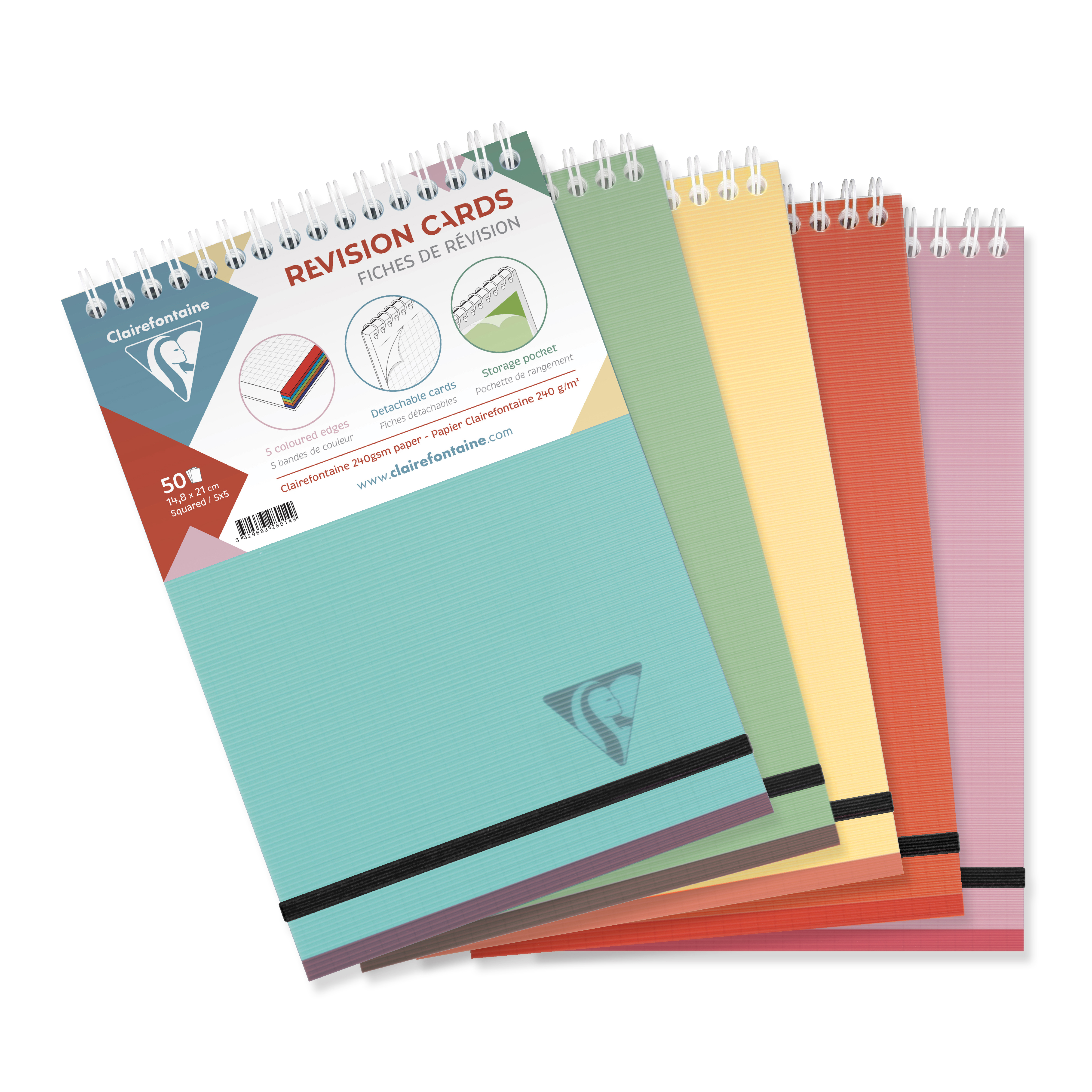
This is where everything happens. A suitable support, such as Revision Cards, can really help:
-
practical format,
-
limited space (so no unnecessary text),
-
comfortable writing experience.
Detachable sheets are ideal for taking them everywhere.
Use colours and diagrams
No need to be an artist:
-
one colour for definitions,
-
another for examples,
-
a box for formulas.
Even a very simple diagram helps the brain memorise faster.
Reread regularly
A sheet forgotten in a drawer is, unfortunately, of little use.
Active revision means:
-
multiple rereads,
-
over short periods,
-
spaced out over time.
That’s what truly anchors information.
Why the Notebook Format Makes Revision Easier
The notebook format changes everything:
-
easy to carry,
-
perfect for commuting or between classes,
-
clear overview of what has already been revised.
And when the paper feels good, writing becomes almost enjoyable — even during exam periods.
Adapting Revision Sheets to Each Subject
Not all subjects are revised the same way. For example:
Literary subjects
Key ideas, dates, authors, concepts.
Scientific subjects
Formulas, demonstrations, problem-solving methods.
Languages
Vocabulary, rules, useful expressions.
The principle remains the same: concise, clear, effective.
Revision Sheets: A Real Confidence Booster
Beyond learning, there’s also mindset. Seeing your revision sheets completed, organised, and regularly reviewed is incredibly reassuring. You feel prepared, structured, and less stressed. And before an exam, that is truly priceless.