






Primary colors are the foundation of color theory. By understanding how to mix them, you can create a wide range of hues to enrich your artistic creations or design projects. In this article, we’ll explore the principles of mixing primary colors to obtain secondary and tertiary colors, along with practical tips to master this art.
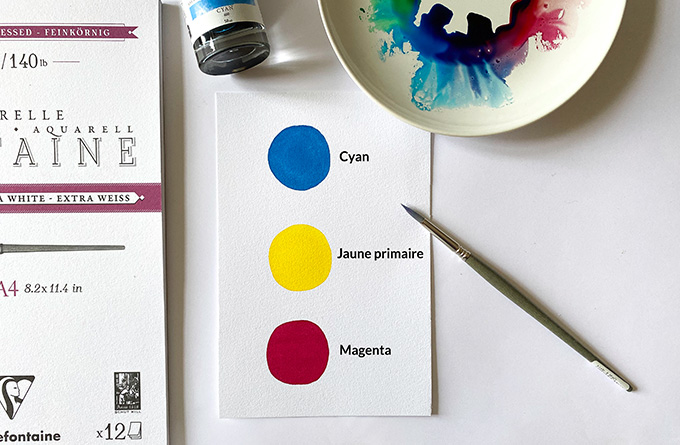
For this exercise, we’ll be using Jacques Herbin watercolor inks and Clairefontaine 100% cotton watercolor paper to achieve the most vibrant and luminous color blends.
What are the primary colors?
Primary colors are fundamental hues that cannot be created by mixing other colors. Traditionally, in painting, the primary colors are red, yellow, and blue. However, in modern color systems — especially in printing — the primary colors are cyan, magenta, and yellow. The latter are often preferred for their ability to produce a wider range of colors when mixed.
Creating secondary colors
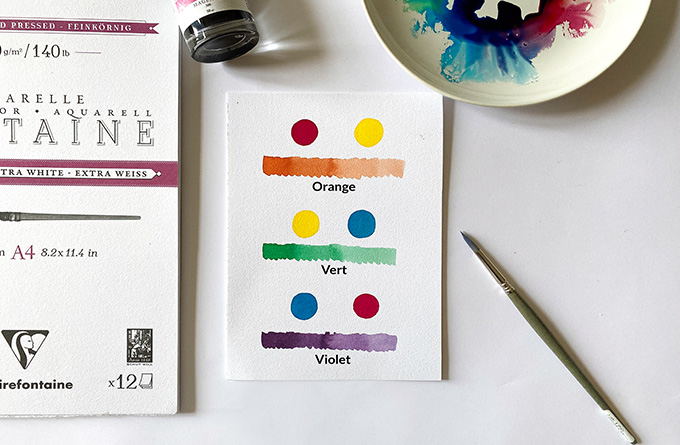
Secondary colors are produced by mixing two primary colors in equal proportions. Here’s how to create them:
-
Orange: mix red (magenta) and yellow.
-
Green: mix blue (cyan) and yellow.
-
Violet (purple): mix blue (cyan) and red (magenta).
For example, by combining red (magenta) with blue (cyan), you’ll obtain a violet (purple) hue.
Exploring tertiary colors
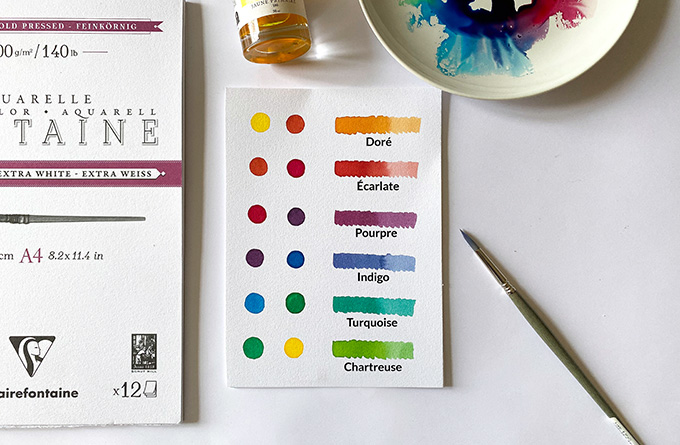
Tertiary colors are created by mixing a primary color with an adjacent secondary color on the color wheel. This process produces more nuanced and complex shades. For example, mixing blue (cyan) with green results in blue-green (also known as turquoise). Other tertiary colors include yellow-orange, red-orange, red-violet, blue-violet, and yellow-green.
Practical tips for color mixing
-
Use pure colors: For optimal results, use high-quality pigments without any pre-mixed tones.
-
Experiment with proportions: By varying the amount of each color, you can create different shades. For example, adding more blue to a blue-yellow mix will produce a cooler green, while adding more yellow will give a warmer green.
-
Consider color temperature: Colors can be warm (reds, oranges, yellows) or cool (blues, greens, violets). Mixing colors with opposite temperatures can neutralize the hue, resulting in more earthy or grayish tones.
-
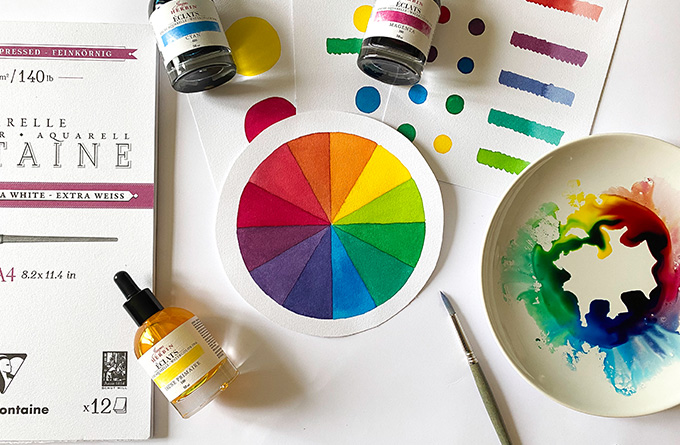
Create your own color wheel: Building your own color wheel helps you better understand the relationships between colors and the possible mixes. Start with the primary colors, then mix them to obtain secondary and tertiary hues.
Mastering the mixing of primary colors is essential for any artist or designer looking to enrich their palette. By understanding how colors interact and practicing regularly, you’ll develop a heightened sensitivity to tones and color harmonies — allowing you to create visually captivating works.